Efectos De La Mediterraneidad Sobre El Patrón De Desarrollo E Inserción Internacional De Los Países En Desarrollo Sin Litoral.
Barra lateral del artículo
Contenido principal del artículo
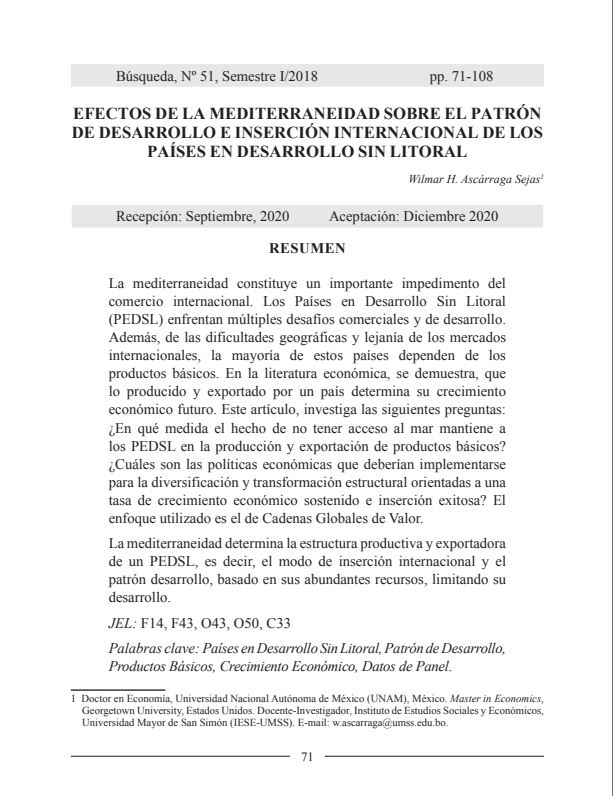
Resumen
La mediterraneidad constituye un importante impedimento del comercio internacional. Los Países en Desarrollo Sin Litoral (PEDSL) enfrentan múltiples desafíos comerciales y de desarrollo. Además, de las dificultades geográficas y lejanía de los mercados internacionales, la mayoría de estos países dependen de los productos básicos. En la literatura económica, se demuestra, que lo producido y exportado por un país determina su crecimiento económico futuro. Este artículo, investiga las siguientes preguntas: ¿En qué medida el hecho de no tener acceso al mar mantiene a los PEDSL en la producción y exportación de productos básicos? ¿Cuáles son las políticas económicas que deberían implementarse para la diversificación y transformación estructural orientadas a una tasa de crecimiento económico sostenido e inserción exitosa? El enfoque utilizado es el de Cadenas Globales de Valor.
La mediterraneidad determina la estructura productiva y exportadora de un PEDSL, es decir, el modo de inserción internacional y el patrón desarrollo, basado en sus abundantes recursos, limitando su desarrollo.
Detalles del artículo
Número
Sección

Esta obra está bajo una licencia internacional Creative Commons Atribución 4.0.
La Revista Búsqueda se publica bajo una licencia Creative Commons Atribución 4.0 Internacional (CC BY 4.0).
Esta licencia permite a cualquier persona: Compartir, copiar y redistribuir el material en cualquier medio o formato. Adaptar remezclar, transformar y construir sobre el material para cualquier propósito, incluso comercialmente. La única condición es la atribución adecuada del trabajo original. Esto significa que se debe dar crédito apropiado, proporcionar un enlace a la licencia y, en su caso, indicar si se realizaron cambios. Bajo esta licencia, los autores conservan la totalidad de sus derechos de autor sobre sus obras, y se les permite el uso comercial de sus artículos, así como depositarlos en cualquier repositorio institucional o temático (autoarchivo), siempre que se respete la atribución original.
Para acceder al texto completo de la licencia, visite: https://creativecommons.org/licenses/by/4.0/deed.es
Cómo citar
Referencias
Ascárraga, Wilmar (2015). Participación y Posición de los países de América Latina y el Caribe en las Cadenas Globales de Valor, Revista Búsqueda 46, IESE-UMSS, Bolivia.
Auty, R.M. (2001): “The political economy of resource-driven growth”, European Economic Review, Vol. 45(4-6), mayo de 2001, 839–46.
Blattman, C., J. Hwang y J. Williamson (2007). “Winners and Losers in the Commodity Lottery: The Impact of Terms of Trade Growth and Volatility in the Periphery 1870–1939.” Journal of Development Economics 82(1): 156–79.
Bielschovsky, R. (1998), “Evolución de las ideas de la CEPAL”, Revista CEPAL, N. extraordinario (LC/G.2037-P/E), Santiago de Chile, CEPAL.
Blomström, M. y Kokko, A. (2007). “From Natural Resources to High-Tech Production: The Evolution of Industrial Competitiveness in Sweden and Finland”. En D. Lederman y W. F. Maloney (eds.) Natural Resources: Neither Curse nor Destiny. Washington y Palo Alto: Banco Mundial y Standord University Press, capítulo 8.
Carbaugh, Robert. (2009). Economía Internacional. CENGAGE Learning. Mexico.
Cattaneo O and Miroudot S (2013). From global value chains to global development chains: An analysis of recent changes in trade patterns and development paradigms. In: Zedillo E and Hoekman B, eds. 21st Century Trade Policy: Back to the Past? Yale University. New Haven, Connecticut, United States.
CEPAL (2006). Panorama de la inserción internacional de América Latina y el Caribe. Santiago: CEPAL.
Corden, W.M. and Neary, J.P., (1982). Booming Sector and De-Industrialisation in a Small Open Economy. The Economic Journal, 92, pp.825–848.
Gregory, R.G., (1976). Some implications of the growth of the mineral sector. Australian Journal of Agricultural Economics, 20(2).
Hausmann, R., C. Hidalgo, S. Bustos, M. Coscia, S. Chung, J. Jiménez, A.
Simoes, M. A. Yildirim (2011a). The Atlas of Economic Complexity. Mapping Paths to Prosperity. Center for International Development at Harvard University, Harvard Kennedy School of Government y Macro Connections MIT Media Lab.
Hausmann, R. (2011b). “Structural Transformation and Economic Growth in Latin America”. En J. A. Ocampo y J. Ros (eds.) Handbook of Latin American Economics. Nueva York: Oxford University press, capítulo 21.
Hausmann y Rodrik, D. (2003). “Economic Development as Self-Discovery,” Journal of Development Economics. Vol. 72, No. 2, diciembre.
Hausmann Hwang, J. y Rodrik, D. (2007). “What You Export Mattters”, Journal of Economic Growth. Vol. 12, No. 1.
Heckscher, E. (1919), The effect of foreign trade on the distribution of income. Ekonomisk Tidskriff, 497–512.
Hummels, D., J. Ishii, y K.-M. Yi. (2001) “The Nature and Growth of Vertical Specialization in World Trade”, Journal of International Economics, 51, pp. 75–96.
Imbs, Jean, and Romain Wacziarg. 2003. “Stages of Diversification.” American Economic Review 93 (1): 63-86.
Krugman P. R, M. Obstfeld y M. Melitz (2012) “International Economics”, nineth edition, Addison Wesley.
Krugman, Paul, 1987, “The Narrow Moving Band, the Dutch Disease, and the Competitive Consequences of Mrs. Thatcher. Notes on Trade in the Presence of Dynamic Scale Economies”, Journal of Development Economics, Vol. 27, No. 1-2, pp. 41-55.
Lall S (2000). The technological structure and performance of developing country manufactured exports, 1985–1998. Queen Elizabeth House Working Paper Series. No. 44. Oxford University. Oxford, United Kingdom.
Larsen E R, (2006). “Escaping The Resource Curse and the Dutch Disease? When and Why Norway Caught Up with and Forged Ahead of Its Neighbors”, The American Journal of Economics and Sociology, 2006.
Lederman, D. y Maloney, W. F. (2007). “Trade Structure and Growth”. En D.
Lederman y W. F. Maloney (eds.) Natural Resources: Neither Curse nor Destiny. Washington y Palo Alto: Banco Mundial y Stanford University Press,
Magud, Nicolás y Sebastián Sosa (2013). “When and Why Worry About Real Exchange Rate Appreciation? The Missing Link between Dutch Disease and Growth.” Journal of International Commerce, Economics and Policy 4, pp. 1—27.
Ohlin, B. (1933), Interregional and International Trade. Cambridge, Mass.: Harvard University Press, 1966.
Osakwe P (2007). Export diversification and the dilemma of African development. Applied Econometrics and International Development. 7(2).
Prebisch, R. (1950). “The Economic Development of Latin America and its principal problems”. Reproducido en Greenaway, D. y Morgan, C.W. (eds.) (1999). The Economics of Commodity Markets. Cheltenham: Edward Elgar.
Radelet S and Sachs J (1998). Shipping Costs, Manufacturing Exports and Economic Growth. Paper presented at the Annual Meeting of the American Economic Association.
Redding S and Venables A (2003). Geography and export performance: External market access and internal supply capacity. National Bureau of Economic Research Working Paper No. 9637. Cambridge, Massachusetts, United States.
Poelhekke, S. y F. van der Ploeg (2007). “Volatility, Financial Development and the Natural Resource Curse.” CEPR Discussion Papers N°6513.
Sachs, J. D. (2005). The End of Poverty, The Penguin Press, New York.
Sachs, J. D., y Warner, A. M. (2001). The curse of natural resources. European Economic Review, 45(4–6), 827–838.
Sachs, J. y Warner, A. (1995 revised 1997, 1999). “Natural resource abundance and economic growth”. National Bureau of Economic Research Working paper, No. 5398, Cambridge, MA.